Existential Opportunities in Education
By Daniel R. Wilder
EDC – Evolutionary Development Consultants
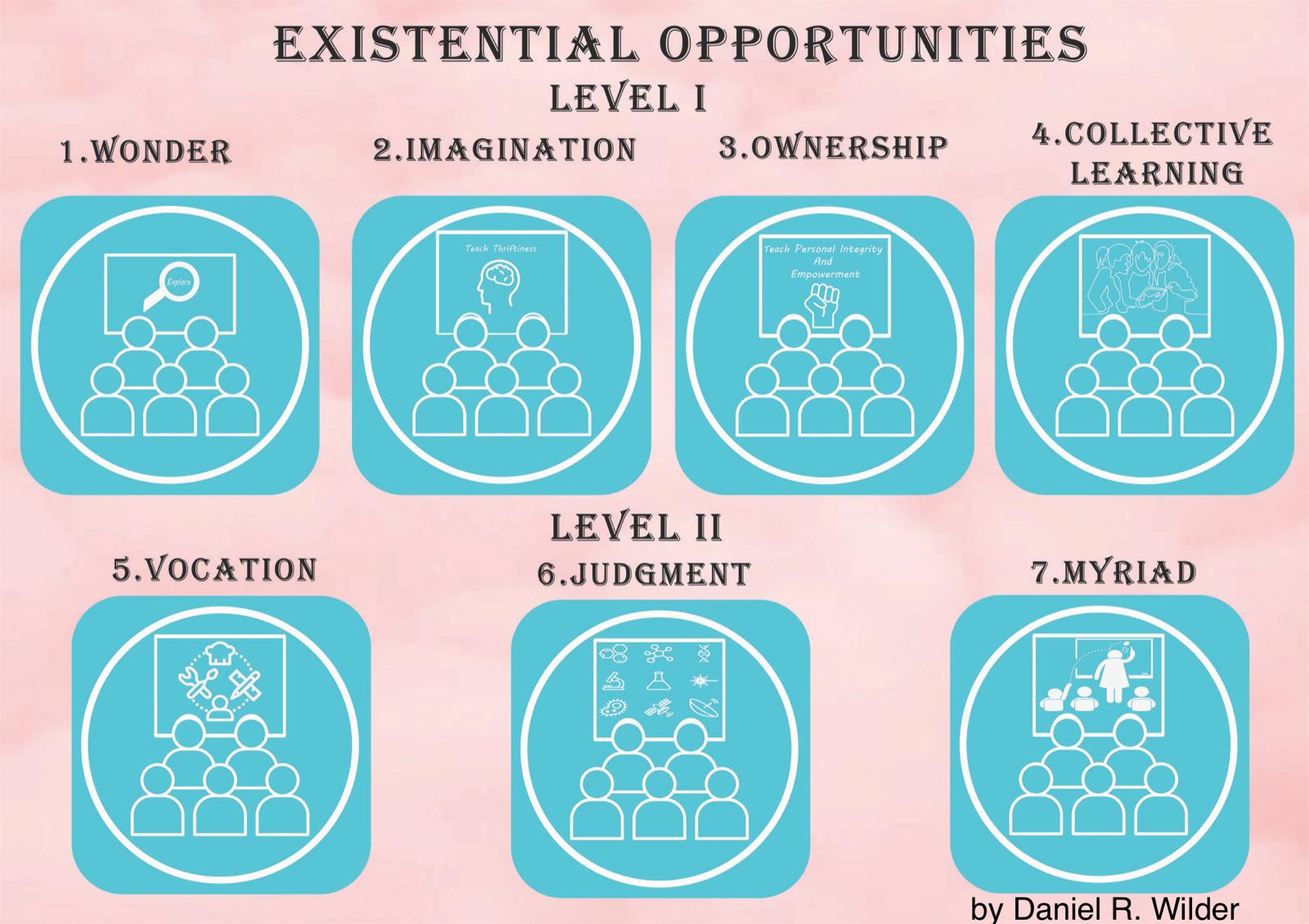
Prior to the involvement of specific content in a program of education, an understanding of human and indeed child nature allows us to identify a somewhat limited set of innate motivations which are at the core of a human's educative potential. These innate motivations show us the pattern of existential opportunities for improving the educative experience of all students.
Lessons which hit upon multiple of these motivations are more likely to make an impact and to stick with more students, whereas lessons which connect to none of these motivations have by definition failed to make an impact. Lessons fail more often not because they lack a portion of scientific content but because the lesson is presented in a way which fails to connect with any innate motivations in the students.
On the other hand, we all know that there are teachers which have a superior ability to connect to students. Even if they were to teach a subject for which they have no special knowledge, these teachers connect directly and empathically with students in a way which encourages engagement. That engagement is coming as a result of the teacher's talent for connecting with students' innate motivations.
These innate motivations show up as existential learning opportunities from the perspective of the school. One specialization of teachers should always be focused on sharing their talent for improving engagement through recognition of these innate motivations.
In this model, 'Level 1' opportunities are more core motivations which are present even in small children who have reached the age of 6. (We are here taking no special consideration of children under 6 who seldom engage in full education programs.) 'Level 2' opportunities on the other hand are those motivations which tend not to open up until the teenage years and cannot reach their perfection before the early 20s.
The 3 Main Motivations
Curiosity, creativity, and agency are the 3 biggest fundamental motivations in human life. These 3, along with collective learning, are the most important to understand and strategically emphasize in general and childhood education programs.
When the curiosity motivation is engaged, it creates in the student an effect which the teacher can recognize as 'wonder', 'bewonderment', etc.. The student moves towards new material and looks more deeply and profoundly without being pushed to do so.
When the creativity motivation is engaged, the teacher can recognize a process of 'imagination' in the student, whereby the student expands upon, reorganizes, and draws external information into the lesson at hand.
When the agency motivation is engaged, it produced in the student a method of behavior which appears to the teacher as 'self-responsibility' and other themes which show the student is engaged in this life as an owner in his own life. Ownership is an expansive theme which connects all the way to adult themes of private property and also shows itself as protectiveness against purile incursions, for which teachers have been historically guilty.
A Note on Freud and Negative Motivation
These first 3 'level 1' opportunities are possibly connected to the Freud's motivation theory as eros, agape, and a third which he might have called agency (if he had focused on defining it). In this case, thanatos, ie. the 'death drive' motivation, would be postulated as the inverse of eros, meaning it represents the inversion of the imaginative drive which seeks to achieve bewonderment with the world.
An overactivity of Freud's thanatos in a student's behavior would therefore denote some problem which is suppressing or inverting the creative motivation. Existential opportunities can also therefore exist in education to remedy overactive negative motivations like thanatos, or those negative motivations which move to counteract or suppress creativity and self-agency.
Collective Learning
Processes which engage learning through partnerships (2 people), small groups (3-7 people), or large grouos (8+ people) are also valid and important to emphasize in a comprehensive learning program. These are distinct and specifically defined environments. Partnerships, small groups, and large groups all operate with distinct characteristics and it is not at all an exaggeration to say that some students may flourish in one environment while faltering in another. The size of a group (1, 2, 3-7, or 8+ individuals) has an innate implication for the educative environment. All of these environments must be engaged in a comprehensive school experience, and students must be identified for their natural strengths and encouraged to emphasize their learning time in the appropriate collective learning environments. appropriate collective learning environments.
It is also true that some students, such as the author of this work, are more likely to find opportunity for deep learning in a solo, independent learning environment. For such students it can never be wished that they become removed from these group activities, but they can be cultivated to enhance their independent learning moreso than other students with less independent learning potential.
The interplay between these learning styles is also fascinating to observe and can be quite rewarding, say for example a student who through independent learning engages his motivation of curiosity and learns something outside of the group which he later brings back to share. This can introduce rich experiences to the group which could not have happened otherwise.
Vocational Learning
In the level 2 learning opportunities, we move away from an emphasis on identifying 'successful learning' symptoms, since all people engaged by these higher motivations are capable of adult-level communication and the teacher doesnt need to be as much a detective in this regard.
Vocation is about having a role in the society, in the community. The ideal vocation is that which is valuable to the society and which the student, with no special aversion, has some special talent for. It can be explored whether all students in a teenage or higher environment could benefit from more vocational focus inside of the school, in the form of things like student government (if they are real decision-making bodies and not simply agencyless puppets of school administrators).
Vocation also extends far beyond the classroom, and part of higher classroom experiences should always be crafted with an eye and a hopefulness for the future engagement of the students in vocations.
It is naturally presumed that more than half of students will of course engage in some form of employment, and that more than 80% of the students will engage in direct and prolonged vocation as mothers and fathers. All other categories such as part-time employment are also relevant, but preparations for workforce entry and child-rearing obviously take a special precedent.
In addition: entrepreneurship, charity, artistry, and also non-earning vocations should also receive their place and emphasis. For many students, these will form the bulk of the fruitfulness of their adult lives as it comes to vocation
One further note here: students must be allowed to emphasiz their true vocational talents in an environment where they are not overly pressure to conform to the talents of others in the group. There are for example, natural vocational specialties which do not exist as recognized professions in our current society due to insufficiency of promoting the connection from inborn talent to vocational specialty. Matchmaker is one example. Most sorts of consultation are not traditional vocations either yet can earn justifiably powerful profits when engaged by the right student with the right talent
Although this tendency decreases with the age of the teacher, your student may have vocational talents which apply to a job or vocation you have never witnessed before. Their talents could be valuable and even fortune-making in an area with which the teacher or administrator has no familiarity
It is not impossible that an entire school with all its faculty and staff could be unable to identify a particular student's highest vocational capabilities. Even these students were not born by accident into this world. With respect and humility, act accordingly.
Judgement
The quality of judgement is the individual's ability to assess objective reality from a perspective of neutrality.Nobody is really very good at this and the reader likely is not as well. However, we can improve and in some cases, become good objective thinkers.
Exercise of the judgment faculty is also called 'critical thinking', 'critical literacy' (Pepi Leistyna), 'critical pedagogy' (Paulo Freire & Donaldo Macedo). All of these concepts point to what we might romantically assume is the core of university education, but it is not.
Universities do engage in judgment-motivated education but their curriculums are usually papered over with social activities, non-critical core curriculum, and simply easier material. There is nothing harder that most people can imagine than to think critically and objectively.
Judgment is the most challenging of the first 6 motivations and requires the greatest level of brainpower and access to concepts to train.
Myriad
There are more existential opportunities in education than these first 6, which is why the concept of the 'myriad' is important to emphasize.Myriad means ten-thousand OR 'numberless' OR 'too many to easily count'. After the first 6, there are other motivations which can be connected to, especially in older adults who have continued their growth process beyond the average levels. Although most teaching methods can be interpreted as engaging with these first 6 innate motivations in the student, methods which do not easily fit in cannot be rigidly dismissed. Alternative methods should be tested for efficacy and not assumed to be either effective or ineffective based purely on the basis of theory: that's the meaning of 'myriad'.
Functionally speaking, myriad means that 'anything which works can be used'. However, methods should be employed to test the efficacy of pedagogy which focuses on other existential opportunities as a source if engagement.
Conclusion
Together, these initial 3 motivations, the additional dimension of collective learning environments, and the addition of vocational and judgement learning constitute the most important emphases for cultivating student engagement...
You can almost stop at the first 4 themes in a lower-level school context designed for students of about ages 11 and below, but teachers with responsibility to exercise foresight about the future prosperity and private citizenship of young students must also be aware and informed of the upper theory as well.
The Level 2 opportunities are best suited for planning an educative experience for adults and children aged 12-22